Dog Separation Anxiety and the Return to the Office
Published · Research-based comparison — how we work · 7 min read
 Snoof's TL;DR
Start the office routine 1–2 weeks before the office does: rehearse departures your dog sleeps through, shift walk and meal times early, and make leaving boring. A stuffed food toy buys 20–30 minutes of distraction; a cheap camera tells you what's actually happening. If you're seeing panic rather than boredom, that's a professional's job — not a gadget's.
Some links may earn us a commission — disclosure.
Your dog has spent years building a model of your schedule, and the return-to-office memo just invalidated it overnight. From the dog’s side, the data changed without explanation: the person who was reliably home is now gone nine hours at a stretch. Some dogs shrug and nap. Some chew a doorframe. The difference is rarely about how much the dog loves you and mostly about whether the new pattern arrived gradually or all at once — which is the one variable you fully control.
Scope note before anything else: this is a practical routine-and-enrichment guide. Actual separation anxiety — panic, self-injury, hours of distress vocalizing — is a clinical problem, and the right move is your vet and a credentialed behaviorist, not a blog post. More on that line below, because knowing which side of it you’re on is most of the game.

Start before your first day back
Every credible guide agrees on the core move, and it costs nothing: don’t let day one at the office be your dog’s day one alone. The American Kennel Club’s (AKC) return-to-work guidance is specific — begin days (ideally a week or two) ahead:
- Run the morning routine for real. Get up at your future work time, do the whole sequence — shower, dress, coffee — and leave at your future departure time, even if only for twenty minutes.
- Rebuild alone-time in increments. Start with the dog settled in another room while you work elsewhere in the home; extend to short real absences; grow the duration as your dog stays relaxed.
- Shift the exercise schedule now. A solid walk before your future departure hour, so the pattern on office days is “tired dog, quiet morning” rather than a sudden drop in activity.
The point of rehearsal is that departures become statistically boring. A dog that’s seen you leave and return forty times without incident has forty data points that say this is fine.
Make leaving and arriving a non-event
Dogs read departure cues — shoes, keys, bag — like a countdown clock, and the ASPCA’s guidance targets exactly that: repeat the cues without leaving (pick up keys, sit back down) until they stop predicting anything. It’s tedious and it works; the ASPCA is honest that this takes “many, many times a day for many weeks” for a sensitized dog.
Then keep both ends of the day flat. Calm, quick goodbyes; calm, delayed-enthusiasm hellos. The AKC’s phrasing is the useful one: dogs “take their cue from you.” A dramatic five-minute farewell tells the dog something significant is happening. Nothing significant is happening. You’re going to a meeting.
Two things not to do. First, per the ASPCA: don’t punish anything you find when you get home — anxious behavior isn’t disobedience, and after-the-fact scolding just makes your return scary too. Second, don’t assume a second dog fixes it. Trainers and behaviorists broadly agree on why: the attachment is to you, not to company in general.
Give the dog a day job
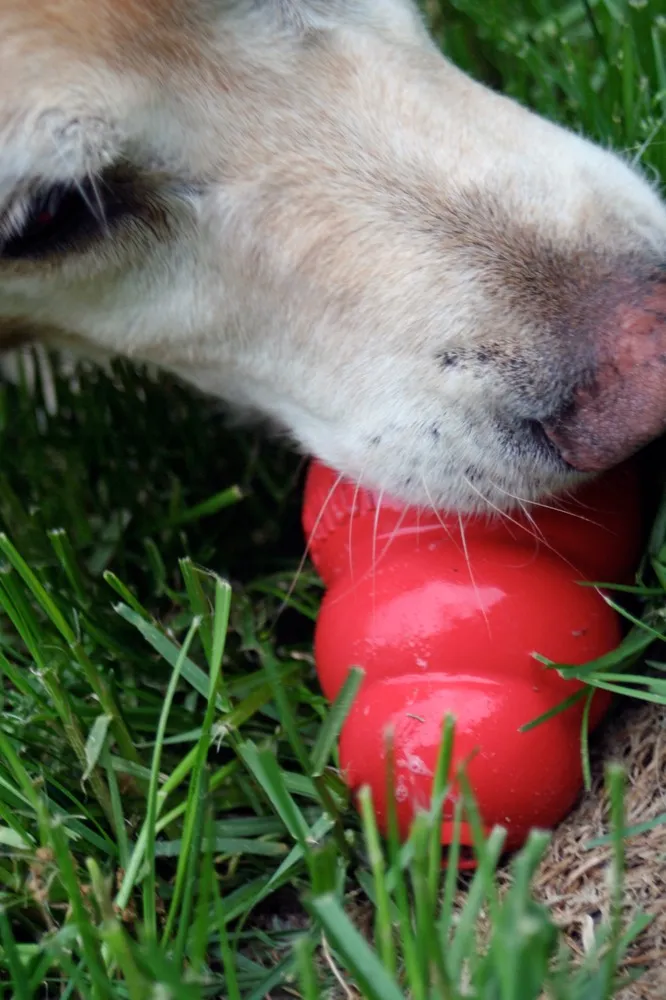
An empty apartment with nothing to do is where trouble starts. The two highest-value lines, both straight from the ASPCA playbook:
- Exercise before you leave. At least 30 minutes of genuine aerobic activity daily, timed so the payout lands during your absence. A sniffy walk counts double — decompression plus tiredness.
- A food project at the door. A stuffed, frozen food-puzzle toy handed over as you leave buys 20–30 minutes of focused work and pairs your departure with the best part of the dog’s day. Rotate a few so the novelty holds. Scatter-feeding kibble around the room does the same job for free.
Midday help scales with budget: a lunchtime walker, daycare a few days a week, or a neighbor swap. Nationally that service line runs about $210–$375 a year for typical use and $900+ in high-cost cities — we priced it in the annual cost of owning a dog.
A camera answers the only question that matters
You can’t fix what you can’t see, and the crucial unknown is what your dog does in minutes 5 through 45. An old phone on a shelf running a free webcam app, or any cheap Wi-Fi camera, settles it. What you’re sorting:
- Boredom — naps, window patrol, some ambient chewing of things you left out. Annoying, solvable with the enrichment above.
- Distress — pacing that doesn’t stop, vocalizing that runs long past your exit, drooling, attacking exits (doors, windows, crate bars). That’s not a training gap; that’s panic.
The camera also tells you your actual threshold — the alone-duration where relaxed becomes not-relaxed — which is the number your gradual-departure practice should stay under. (The ASPCA’s rule: if you see stress, shorten the absences and rebuild.) One adjacent note from our usual beat: a panicking dog that breaches a door or window is a lost dog scenario, and bolting-prone dogs are the population GPS trackers actually serve — but a tracker is recovery gear, not treatment. Know what to do in the first hour anyway.
Where DIY ends
Draw the line honestly. If the camera shows panic — self-injury, escape attempts, sustained howling, house-soiling only when alone — or your gradual-departure practice can’t get past a few minutes, stop running experiments on your own dog. The escalation path the ASPCA lays out: your veterinarian first (to rule things out and discuss options — that conversation is theirs, not ours), and a credentialed professional for the behavior work — a Certified Applied Animal Behaviorist (CAAB) or a board-certified veterinary behaviorist (Dip ACVB). “We tried a camera and a Kong for three months first” is an expensive way to arrive at the same appointment.
FAQ
How long before my return-to-office date should I start?
One to two weeks of daily rehearsal is the widely recommended runway — enough for dozens of low-stakes departures. Started late? Compress the same sequence into whatever days you have; even three days of rehearsed departures beats zero.
Should I crate my dog while I’m at the office?
Only if the crate is already a settled, positive space and the camera shows your dog relaxed in it during absences — some dogs do worse confined, and the ASPCA warns that dogs distressed in a crate may injure themselves trying to escape it. A dog-proofed room with water and the food project is the safer default for a full workday. Either way, a midday break for anything past four to six hours.
Does getting a second dog fix separation anxiety?
Usually no. The distress is about your absence, not a lack of company in general — which is why a new dog rarely changes what happens when you walk out the door. A second dog is a fine decision on its own merits (and a second food bill; see the cost math), but it’s not a treatment plan.
Which breeds handle alone time best?
Independent, lower-energy breeds have the edge — several of our apartment breed picks were chosen partly for that. But individual history beats breed every time: any dog that’s never practiced being alone can struggle, and plenty of “velcro” breeds do fine with a properly built routine.
Sources
- ASPCA — Separation Anxiety — counter-conditioning, food-puzzle timing (20–30 min), departure-cue desensitization, 30-min exercise guidance, threshold rule, no-punishment guidance, CAAB / Dip ACVB referral path (accessed August 2026)
- AKC — How Separation Anxiety Might Impact Your Dog When You Return to Work — pre-return routine rehearsal, graduated departures, calm departures/arrivals, pre-departure exercise (accessed August 2026)
- Rover — The Cost of Dog Parenthood in 2026 — walking/daycare service costs ($210–$375/yr typical; $900+ in high-cost cities) cited in the midday-help section (accessed August 2026)
Photo credits
- Dog at window photo: Jules Verne Times Two via Wikimedia Commons, CC BY-SA 4.0 (resized)
- Dog with food toy photo: Hawkins via Wikimedia Commons, CC BY 2.0 (resized)
SniffTester is reader-supported. Some links on this page may be affiliate links, which earn us a commission at no extra cost to you. We are not sponsored by any brand we cover. Full disclosure.